

Every university student knows this feeling: the paper is almost finished, it’s late at night, coffee is cold, and then you remember the references. APA, MLA, Chicago, Harvard… commas in the wrong place, italics missing, the year formatted incorrectly, and suddenly your grade is at risk. Manual citation has long been one of the most frustrating parts of academic and professional writing.
At the same time, the demand for content keeps growing in education, SEO, and digital publishing. We write more and faster, but spend less time on technical details. This is exactly where AI citation generators come in. These tools use natural language processing and large databases to automatically extract source metadata, format references, and ensure compliance with academic standards. In simple terms, AI takes over the most boring part of writing and lets us focus on ideas instead of brackets and punctuation.
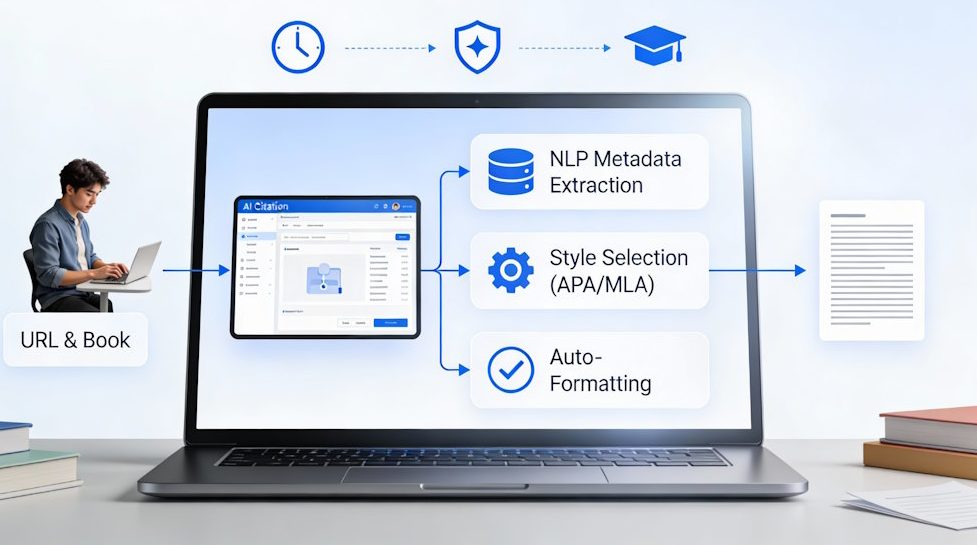
At the core of AI citation generators are several technologies that sound complex but work in a very logical way. The first is NLP (natural language processing). When you paste a URL, DOI, or ISBN or upload a PDF, the system “reads” the content by identifying patterns and key elements such as author names, titles, publication dates, and publishers.
Next comes metadata extraction. Many tools rely on APIs from databases like Crossref or Google Scholar to retrieve accurate bibliographic data. This is especially important for academic articles, where even a small mistake can make a citation incorrect.
Machine learning plays a major role as well. Models are trained on massive datasets of properly formatted references, which helps them recognize different source types — websites, books, journals, reports. Thanks to this training, AI can handle variations, such as missing authors or unclear publication dates.
As a result, the generator does not simply copy information — it understands what kind of source it is dealing with and applies the correct formatting rules.
From a user’s perspective, generating a citation looks simple, but internally, the process includes several steps.
First, the user submits a source identifier — a link, DOI, ISBN, or file. The AI then either scrapes the page or queries external databases. Since the retrieved text is often unstructured, the system parses it using regular expressions and named entity recognition to extract authors, titles, and dates.
After that, the data is validated against the rules of the selected citation style. If the information is incomplete or ambiguous, the tool may assign confidence scores and choose the most likely option. This is part of error handling: the AI signals uncertainty rather than silently producing incorrect results.
Finally, the formatted citation is generated and ready to use, while still allowing manual edits if needed.
Most AI citation generators support the main academic formats. APA follows an author–date system and is widely used in the social sciences. MLA focuses on author–page references and is common in the humanities. Chicago offers a more flexible notes-and-bibliography approach.
One of the biggest advantages of AI tools is adaptability. When citation rules change, such as the transition to APA 7th edition, generators update their rule-based engines and retrain models accordingly. For students, this means less time spent reading new guidelines and more confidence in formatting accuracy.
Several AI citation tools are widely used today. QuillBot offers quick auto-citation from URLs and works smoothly alongside its writing tools. Sourcely focuses on source discovery and bulk citation processing, which is useful for literature reviews. Anara stands out for its integrations with Google Docs and collaborative workflows.
Another practical option for students is the EduWriter APA Format Generator, which is designed specifically for APA-style references. It helps users quickly generate accurate citations without digging through complex style manuals, making it especially helpful for essays, research papers, and coursework.
Most tools offer free versions with limits, while premium plans are better suited for content strategists and SEO professionals who need speed and scale.
While AI citation generators offer clear time-saving benefits, they aren’t flawless. Issues like unreliable source data, paywalled publications, or missing metadata can still cause errors in generated references. This is why human review remains critical, particularly in sensitive fields such as legal research or work handled by an intellectual property firm, where accuracy is non-negotiable.
The safest approach is straightforward: always verify citations against primary databases, compare outputs from more than one tool, and view AI-generated references as helpful support rather than unquestionable authority.