

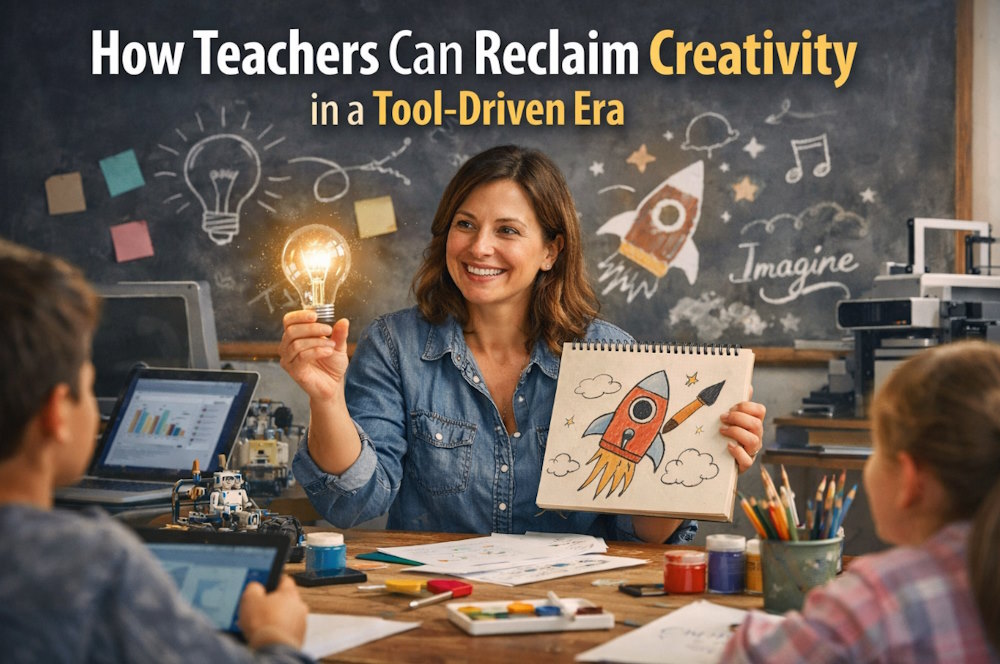
Despite being a physically and emotionally demanding job, teaching can be very fulfilling.
The contentment and joy that come with teaching are not just from the satisfaction of watching children learn and grow; it comes from creating a classroom where students can gain knowledge with joy and experience the satisfaction of applying their knowledge successfully.
However, with technology dominating each sector, education is also being saturated with specialized tools and learning platforms. And, while this takes away a lot of stress from teaching, it also reduces the room to get creative with how you teach.
Taking creativity away from teaching is like taking away the soul of education, which is why you must reclaim it. Let’s take a look at a few ways you can reclaim creativity, even in an era dominated by tech, tools, and AI.
Creativity in teaching is often misunderstood. Many assume it requires dramatic lesson plans or artistic flair, but in reality, it lives in smaller, quieter decisions. It appears in the way a teacher explains a concept, the examples they choose, or how they respond to a student’s question in the moment.
In a tool-driven environment, it becomes easy to rely on ready-made content that feels complete but lacks individuality. When everything is pre-designed, the teacher’s voice can slowly fade into the background.
This is where awareness matters. Even something like an AI detector highlights how predictable and uniform generated content can become. Creativity, by contrast, thrives on variation and human nuance.
When teachers begin to see creativity as flexibility rather than performance, it becomes more accessible. It is not about doing more, but about doing things differently, even within the same structure.
The most engaging classrooms are rarely built on subject knowledge alone. They are shaped by the teacher’s personality, interests, and experiences outside of teaching. Creativity grows when educators allow different parts of their lives to influence how they teach.
A teacher who enjoys music might use rhythm to explain patterns. Someone who writes might bring storytelling into explanations. Even simple, everyday experiences can make lessons feel more grounded and relatable. These elements cannot be generated by a tool because they come from lived experience.
Students are highly responsive to authenticity. They are more likely to engage when lessons feel human rather than mechanical. In this way, creativity becomes less about technique and more about presence.
Creativity does not develop in isolation. Some of the best ideas come from observing how others teach, adapt, and experiment. In today’s world, connecting with other educators is easier than ever, yet many teachers remain confined to their immediate environment.
Engaging with teaching communities, whether online or in person, opens the door to new perspectives. It allows teachers to see how similar challenges are approached in different ways. Often, inspiration comes not from polished experts but from everyday teachers trying something new.
These interactions create a ripple effect. One idea leads to another, and over time, teachers begin to shape their own creative approaches. It becomes less about copying and more about evolving.
Creative teachers tend to notice things others overlook. They collect small ideas, techniques, and moments of inspiration, even if they do not use them immediately. This habit builds a quiet reservoir of possibilities.
In a fast-paced teaching environment, not every idea can be applied right away. But storing them, whether digitally or mentally, allows them to resurface when needed. A strategy seen months ago might suddenly fit perfectly into a current lesson.
This process also reduces pressure. Teachers do not need to constantly invent something new. Instead, they draw from what they have already gathered, adapting it to fit their context.
One of the biggest barriers to creativity is not external pressure but internal doubt. Many teachers hesitate to experiment because they fear failure or believe they are not naturally creative.
This mindset is often shaped by systems that prioritize correctness and consistency. Over time, it can limit a teacher’s willingness to try new approaches. But creativity is not an inborn talent reserved for a few. It is a skill that develops through use.
When teachers allow themselves to take small risks, they begin to rebuild confidence. Even when something does not work as expected, it provides insight. That process, more than the outcome, is what strengthens creative thinking.
Creativity becomes stronger when it is treated as a regular practice rather than an occasional effort. Small, consistent changes can gradually transform how a teacher approaches their work.
This might involve adjusting how lessons begin, introducing brief moments of curiosity, or rethinking how questions are asked. These changes do not need to be dramatic. What matters is consistency.
Over time, these small shifts build momentum. Teachers begin to feel more comfortable adapting in the moment, and creativity becomes a natural part of their teaching style rather than something forced.
Trying new approaches is essential, but without reflection, growth remains limited. Experimentation allows teachers to break away from routine, while reflection helps them understand the impact of those changes.
A lesson that feels engaging does not always lead to effective learning, and a simple activity can sometimes have a deeper impact than expected. Taking time to think about these outcomes helps teachers refine their methods.
This process does not need to be formal. Even brief moments of reflection can shape future decisions. Over time, it creates a cycle of continuous improvement where creativity becomes more intentional and effective.
Technology is often seen as the reason creativity is declining, but it can also be part of the solution. When used thoughtfully, it reduces repetitive tasks and gives teachers more space to focus on meaningful interactions.
The key is balance. Tools should support teaching, not define it. A teacher might use technology to generate ideas, but the real value comes from how those ideas are adapted and delivered.
When teachers remain actively involved in shaping their lessons, technology becomes a partner rather than a replacement. Creativity is preserved because the human touch remains at the center.
At its core, creativity is deeply connected to energy and motivation. Teachers who feel drained or disconnected often struggle to bring creativity into their classrooms.
Reconnecting with the reasons they chose teaching in the first place can make a significant difference. Small moments, a student understanding a difficult concept, an unexpected question, or a shared laugh, can restore a sense of purpose.
These moments are not separate from teaching. They are what make it meaningful. When teachers begin to notice and value them, their energy shifts. Creativity naturally follows.
Creativity does not need to be reserved for special lessons or extra time. It can exist in everyday teaching through small, intentional choices.
Even within structured systems, there are moments of flexibility. A transition between activities, a different way of explaining a concept, or a slight variation in a task can all introduce creativity into the classroom.
These small adjustments may seem minor, but they accumulate over time. They shape a learning environment where curiosity is encouraged, and students feel more engaged.
Reclaiming creativity in a tool-driven era is not about rejecting technology or completely changing how teaching works. It is about finding balance. It is about remembering that AI tools are there to support the process, not replace the person leading it.
Teachers still hold the most important role in the classroom. Their ability to connect, adapt, and respond to students cannot be replicated by any system. Creativity lives in those moments where teaching becomes personal, flexible, and meaningful.
As education continues to evolve, the challenge will not be keeping up with new tools, but holding on to what makes teaching human.
When teachers embrace their own voice, trust their instincts, and allow space for experimentation, creativity naturally finds its way back. And when it does, it transforms not only the classroom experience but the way students learn, think, and engage with the world around them.