

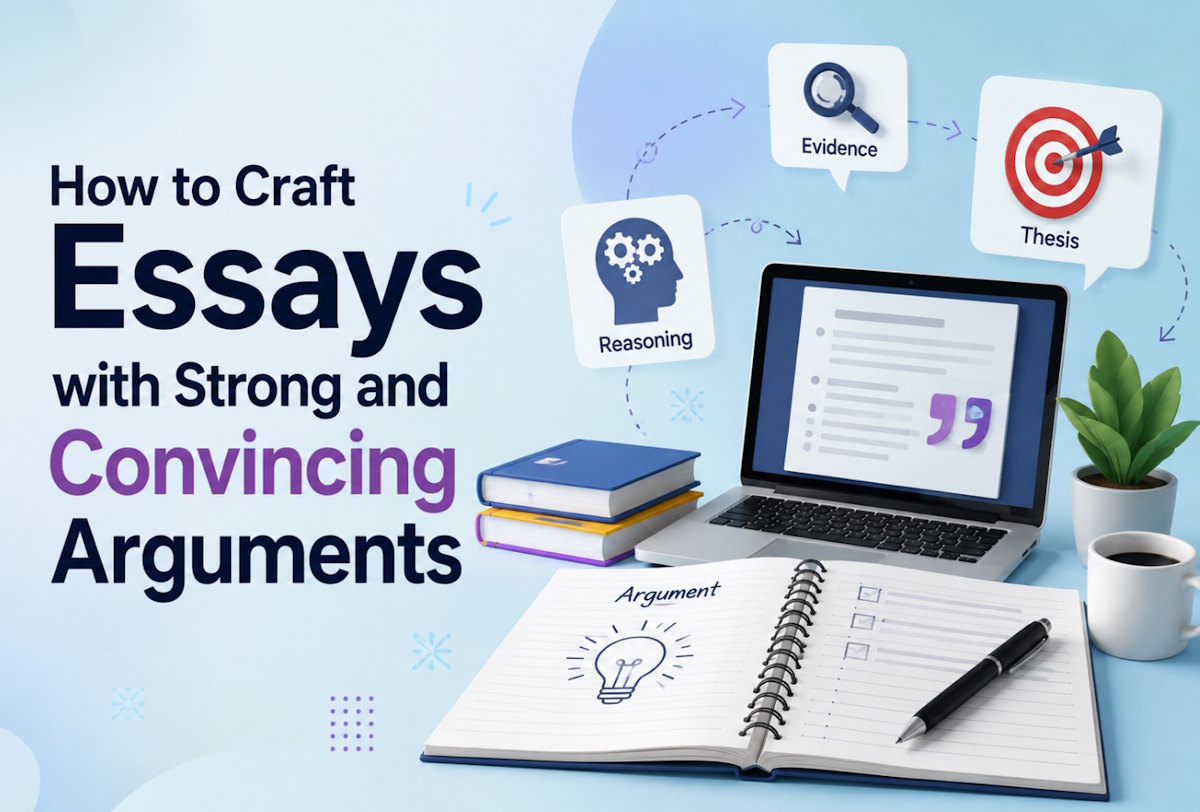
An essay full of opinions without any actual backing just reads like someone talking, not really convincing anyone of anything. A strong essay needs proper arguments, ones that actually hold up when someone reads them critically, not just statements thrown in without support.
A lot of students struggle exactly at this point. Ideas are there, but turning them into arguments that actually convince the reader is a different skill altogether. It is all about writing arguments that are structured and backed properly.
In this blog, we’ll go through how you can craft essays with arguments that are actually strong and convincing, instead of just filler text taking up space on the page.
Every strong essay starts with a proper thesis statement. And this one line basically decides how convincing the whole essay will be. A weak thesis, something too general or obvious, doesn’t give the writer much room to actually argue anything. That is because there is nothing really to start a debate.
A good thesis statement should take an actual position, something someone could reasonably disagree with. If everyone would already agree with your thesis without any convincing needed, it’s probably too weak or too obvious to build a proper argument around.
This one line at the very start also sets the direction for the rest of the essay. Every paragraph should contribute to developing, supporting, or examining the thesis. So getting it clear and specific from the beginning makes the rest of the writing easier to build and stay focused on the actual point being argued.
A claim without any backing is just an opinion. And opinions alone don’t really convince a reader of anything. Every argument made in an essay needs some actual evidence behind it. Evidence may include facts, statistics, expert opinions, research findings, or relevant examples. This is why the strongest essays lean on empirical research, where every claim traces back to real data rather than assumption.
Also, this evidence should come from reliable sources too. Your argument is weakened if you back up your key points with unreliable sources. A reader who notices weak evidence starts to doubt the rest of the essay, too.
Each piece of evidence used should also directly connect to the point it’s supporting. Properly backed arguments hold up a lot better under scrutiny. And that’s exactly what makes an essay actually convincing.
Ignoring the other side of an argument completely actually makes an essay weaker, not stronger. So if a reader knows the counterargument and the essay doesn’t mention it, they start to question whether the writer really thought the topic through properly or just wrote from one side and didn’t consider anything else.
If the writer gives an argument against his/her point and then refutes it, it shows that the writer knows the subject from more than one side. It does not mean equal space for the other side, just enough to suggest it is there and then show why the main case still stacks up better by comparison.
In fact, this makes the essay even more persuasive overall because it seems like the author has already considered possible counterarguments, instead of leaving it to the reader to come up with counterpoints that the essay itself didn’t even bother to address.
Powerful individual arguments are meaningless if they are put together with no real connection between them. The reader should be able to see how one point leads to the next, gradually building toward and supporting the overall thesis.
Ideally, each paragraph should build on the previous one instead of making a sudden leap to an entirely new angle. Proper transitions between paragraphs help here too. Such phrases link the previous point to the one coming next. This way, the whole essay reads like one continuous argument and not just scattered pieces put together.
Even the most well-planned essay has weak spots, which only become apparent on a second read. It may be an argument that sounded good when written but feels weak when actually reviewed properly. That’s why it’s important to revise for the strength of arguments.
You can go through each argument one by one and see:
Sometimes a point that seemed like good writing turns out to be a repetition of an earlier argument.
Also, it helps to take a short break before this revision step. When you come back after some time, you can more easily spot weak arguments objectively.
Yes. All the points discussed above, including thesis, evidence, addressing the other side, logical flow, precise language, and proper revision, are very important. These are the actual foundation of a strong essay. There is no real shortcut around understanding them.
But sometimes the struggle is not about knowing these points. It is about actually applying them, like connecting one argument to the next in a way that flows properly. If that part feels stuck, AI essay writing tools can help provide you with a starting point for structuring your ideas and arguments.
You can generate a draft to see how it structures its arguments and transitions. You can also customize it in your own words and add your own evidence and reasoning to it. We tested several tools for generating argumentative essays and found these two useful for creating an initial structure and draft.
This tool provides more than a dozen essay type options. You can select the “Argumentative” type from the drop-down to obtain a solid first draft for writing an essay with strong arguments.
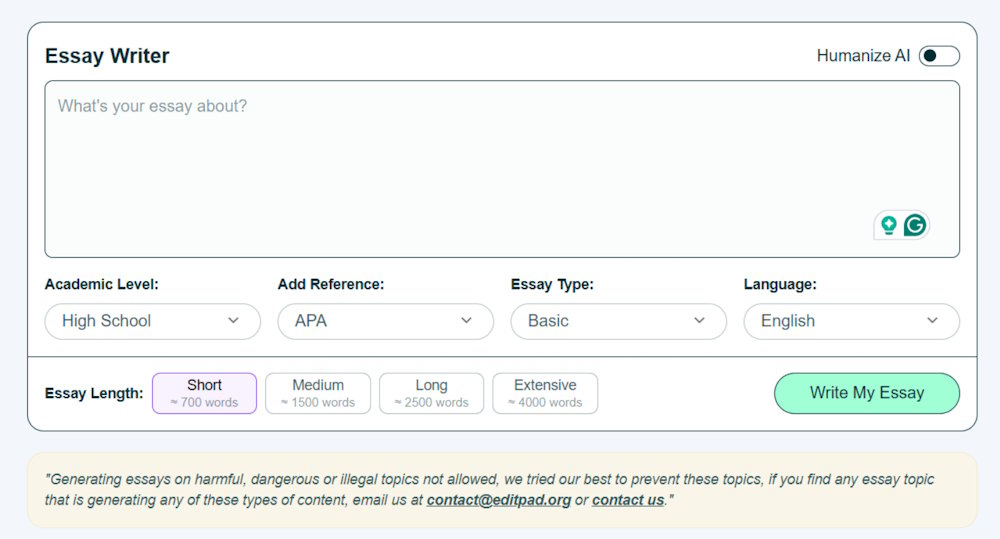
It will generate a draft that’s already structured around building a position and backing it up, which is closer to what’s actually needed.
To use it, enter your topic, pick your academic level and essay type, essay length, and, if needed, select a citation style too. APA, MLA, Harvard, IEEE, or Chicago are all available. Hit “Write My Essay,” and it generates a structured draft with an intro, body, and conclusion. It’s free to use without needing to sign up.
Essayness works on a similar idea: enter your topic, pick essay type and word count, and it generates a full essay with proper structure.
It also offers a “Humanize AI” option for a more natural-sounding draft and includes referencing support too. This matters for essay arguments especially, since a stiff, robotic tone can actually weaken how convincing a point sounds. Even strong reasoning can be less effective if the writing feels unnatural or overly formulaic, so reviewing and refining the draft is still important.
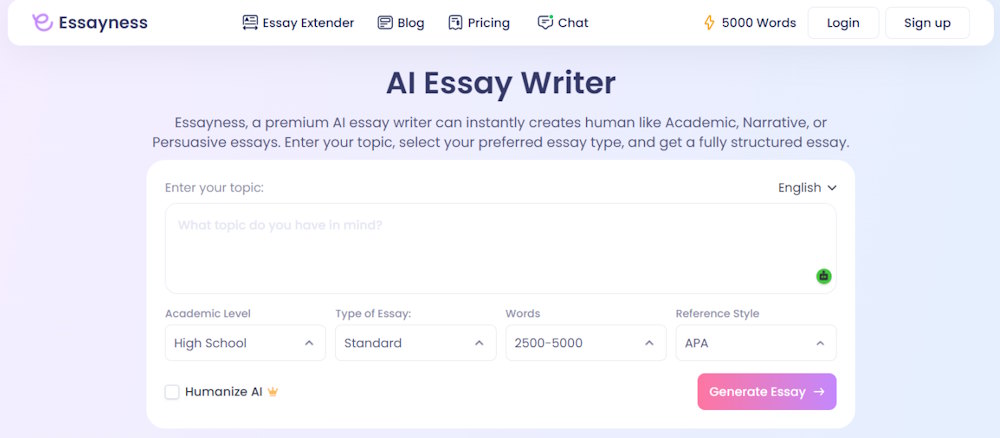
The same rule applies here: use the output as a rough starting frame for your arguments and structure, then build on it with your own research and proper revision, rather than using it as the final version.
So, the key to writing persuasive essays with convincing arguments is to get the basics right. You need a clear thesis, solid evidence, acknowledgment of the other side, logical flow, confident language, and careful revision. When you are struggling with how to structure or link your arguments, AI tools like Editpad and Essayness can help you. But they are best if the output is used as a starting point, not as the final piece.
Follow the flow in the draft they give you and then rebuild it with your own thinking, evidence, and voice. That’s what makes an essay convincing.