

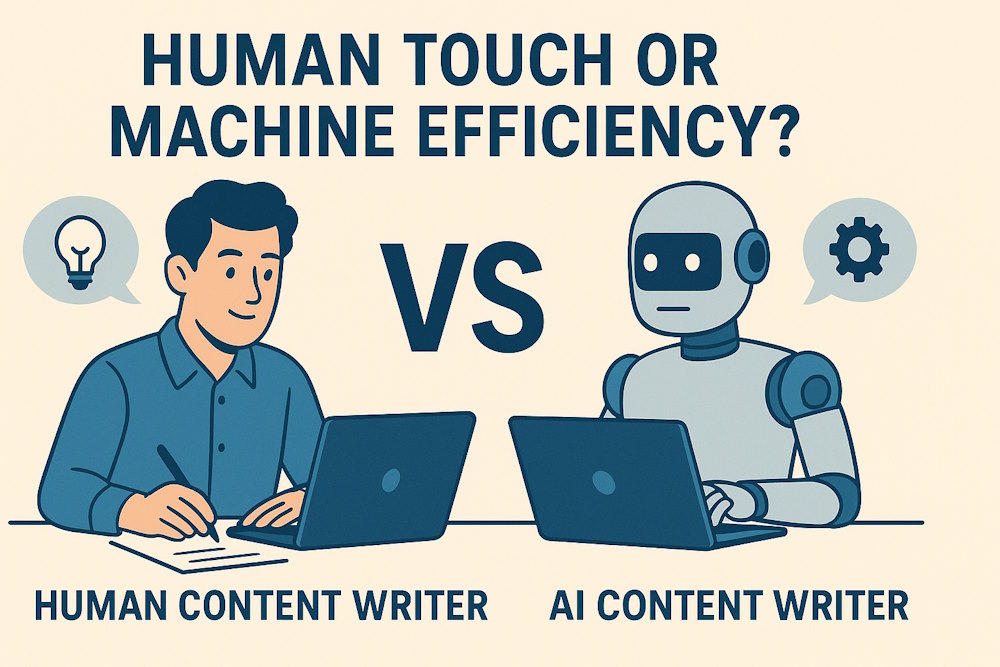
The arena of content generation is changing fast because of the advent of advanced AI Writer tools offering high speed and efficiency. This development has put conventional human content writers in a fresh competition. The situation allows for careful analysis of the respective features, advantages, and disadvantages of each. Insightfully, the issue is no longer one of replacement, but instead understanding their fundamental differences on important metrics like creativity, speed, cost, and authenticity, thereby outlining what is best practice for current content.
The most fundamental difference lies in creativity. Only human content writers have genuine intelligence and the ability to feel, thanks to their lived experiences. Thus, they can create incredible original content. Through the use of nuance, satire, and humor, their work typically features a deep and personal voice. A writer’s role is to think. They combine ideas, they make sense of ideas, and they also create ideas. Conversely, an AI Writer operates on patterns. The application creates content based on extensive data that it learned from or by remixing and rewording information. Even though it is readable and correctly written, it often lacks a quality of ‘spark” that makes it feel generic or formulaic. AI creativity relies on patterns, while human creativity is innovative. This dependence on past information also has a potential problem: being unoriginal can help generate a “sea of sameness” online that search engines and sophisticated AI detector tools are increasingly being designed to identify. Human writing will always be essential for content that needs to stand out, be strategic, or evoke emotion, like thought leadership pieces or brand stories.
Secondly, speed and scalability are the other factors that mark the difference between human and AI writers. AI Writers are the best when it comes to production volume and speed. An AI tool can create hundreds of product descriptions, social media posts, or full-length draft articles in seconds or minutes. This scalability is vital in tasks that demand speed in high-volume, repeated tasks. An e-commerce site with thousands of products, for example, can easily generate basic copy for each one with the help of AI. Moreover, AI can optimize that copy with the target keyword. On the other hand, human writers take much longer to create content. Though going slower, this intentional pace plays a key role in depth and quality. The time taken by a person ensures the content is well-researched, factually accurate, and matches a specific brand voice so thoroughly that it reduces later revisions.
When it comes to human and AI writers, costs and efficiency have been issues of much debate. AI writers seem to be the most affordable option on the surface. Usually, it is just a small monthly subscription. The subscriptions enable businesses to produce massive quantities of content at a fixed, low cost. As a result, a large in-house team or pricey freelancers are unnecessary. But the total cost of content paints a more complicated picture. An editor must adapt AI-generated content to meet the reference standards. AI has “hallucinations” and presents false/misleading facts confidently. This is why they need a human grader and validator, particularly in specialized or highly regulated industries. If cheap AI content is not authentic enough to convert, the initial low cost results in a poor return on investment (ROI). To that extent, although a skilled human content writer might cost more at first, their quality final drafts require less revision, have greater long-term value, and are more effective in engagement and conversions.
Additionally, authenticity and empathy are the human content writers’ greatest assets. By using human feelings such as fear, anger, and more, human writers create information that cultivates trust. In an advertisement, for example, a human writer understands the cultural references, the changing slang of the time, and the implicit context of the target audience. Thus, they can perfectly write a brand’s tone of voice. When one communicates in a manner that seems warm and genuine, their casual readers become customers. Notably, while an AI Writer’s tone may mimic a person, it does not feel besides lacking self-awareness. AI cannot use personal experience to influence or aid writing. Also, AI-written text can be grammatically accurate but may sound bland, alien, or too clinical. It misses out on a brand personality unique to humans. Using AI paraphrasing for non-advanced duplication may result in content that, although syntactically correct, is contextually odd. It will lessen authenticity further. Overall, nothing can replace the human touch, where emotions and trust are important.
At the end of the day, there is no win in the best content strategy, but a partnership. AI Writers are wonderful super copilots, taking over the heavy lifting of making outlines, recommending keywords, and creating solid first drafts. This allows human content writers to spend their time on even more high-value tasks: coming up with what the overall piece needs to say, doing deep research, adding emotion to the content, avoiding errors of fact, and infusing their unique creative voice within the copy. By harnessing the speed and scale of AI, while also embracing human touch’s invaluable creativity and depth, brands can have both volume and impact.