

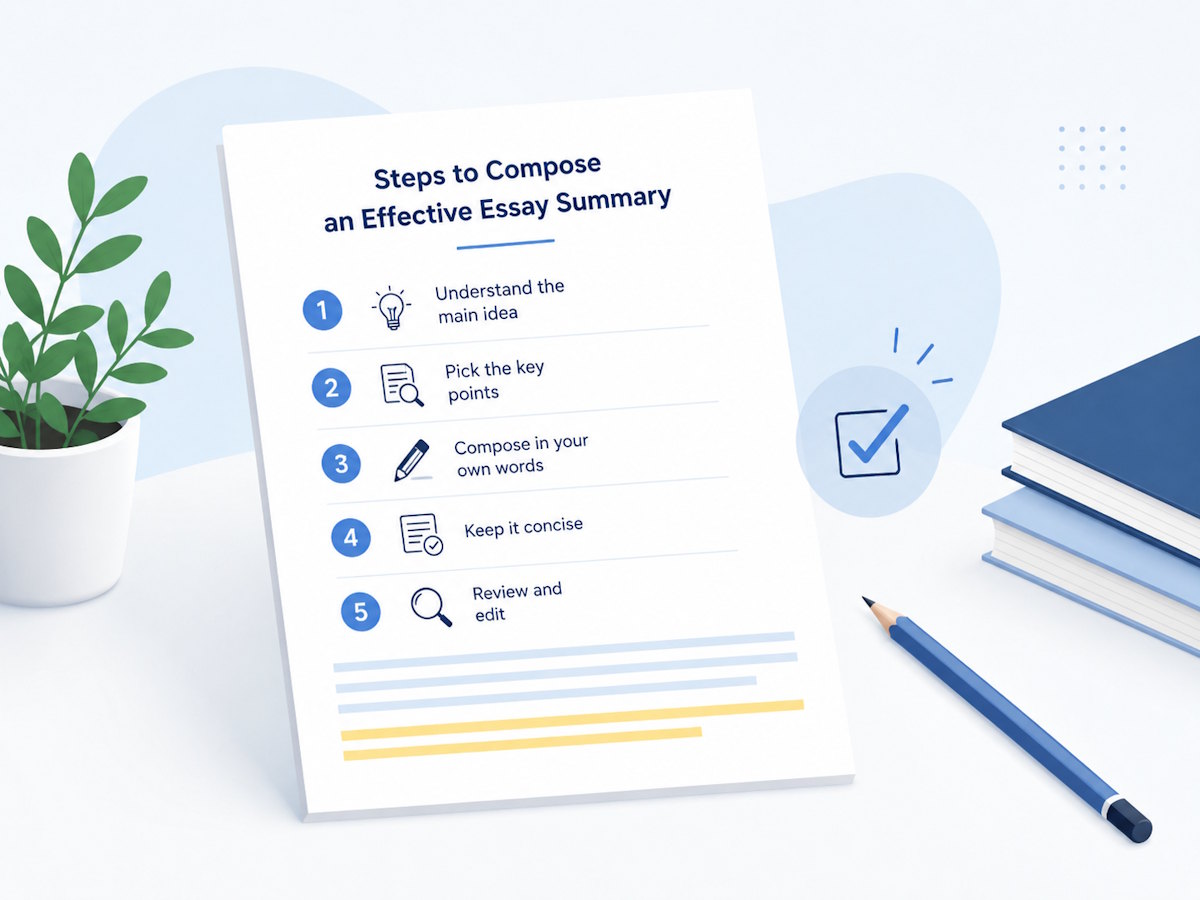
An effective essay summary captures and explains the main ideas of an essay in a concise form to save readers valuable time and effort. However, it is true that creating this summary can be a challenging task for many.
If you are one of them, then there is good news for you. Following the right steps can make the process a lot simpler and more efficient. Simply read the entire essay carefully, identify key ideas, and present them concisely. That’s it.
This blog post is going to explain all these steps in detail. It will be worth reading!
Below, we have discussed the most crucial steps for composing a summary of an essay.
The most important step in composing an effective summary is to first understand the main message of the essay. Here, many make a common mistake – they rush towards picking key points without understanding anything.
You shouldn’t do that; instead, focus on reading the entire essay carefully to determine what message or idea the author is trying to communicate. Specifically, pay close attention to the introduction, as it often presents the core purpose of the essay.
While consuming information, you can consider asking the following questions:
Answering these questions will give you a clear understanding and make the summary creation process a lot easier.
The next step is to skim through the essay (not detailed reading) to identify and pick the most important points and information. There is no need to pick every point; aim to go with the ones that are enough to comprehend the overall message of the essay.
You need to look for the following:
At this stage, many get confused between two things: important points and supporting details. Key information is basically the core idea the author wants you to know. On the other hand, supporting details consist of facts, examples, and scenarios used to explain and prove the main message.
Remember, there can be multiple supporting details for a single idea or argument. You should pick only the most relevant supporting details.
Tip: You should write down important points on a notepad. Doing so will reduce the chances of leaving out key information while writing.
This is the step that requires maximum effort from your side. Once you have got the main points, start writing a summary. A wise approach is to use your own words and phrases instead of completely copying sentences.
Here is what you need to do:
Do not add information such as personal opinions or assumptions that the original essay doesn’t contain. This is because the objective of an essay summary is to explain what the author has said, not your personal interpretations.
A core characteristic of a summary is that it is concise and to the point. So, while writing, you should avoid using unnecessary words, phrases, or even information. Besides this, there are multiple things that you can do to write concisely.
When making such changes, it is important to make sure that the original meaning and quality remain the same.
However, if you are still facing hurdles in keeping the essay summary concise and to the point, consider getting assistance from text summarizers. There are many options available online, with AI Summarizer standing out as a notable choice. It shortens the given content according to the length adjusted by the user.
Relying on such a smart tool will save you both time and effort.
Finally, once you have composed a summary, take time to review it thoroughly. Even if you have followed the aforementioned steps, your draft may still contain flaws.
So, it is better to give it a final review. This will help you ensure:
If you notice anything that isn’t up to the mark, do not hesitate to make edits again. Also look for potential grammar, spelling, and punctuation errors. These mistakes not only impact the summary quality but also damage your professional reputation.
So, these are a few essential steps that you need to take for composing a good essay summary.
There is no doubt that composing an effective essay summary is a challenging skill. However, it can become much easier if the right approach is followed. Start the process by understanding the core message of the essay, identifying the main information, and writing a concise summary in your own words. In this blog post, we have explained all these steps properly.
Hopefully, you will find this article useful and interesting.