

AI essay graders have become a practical option for teachers who deal with a steady stream of student writing. Instead of reading every paper from the first sentence to the last and then calculating a score manually, educators can use AI to make a first assessment and review the result before giving the final grade.
But accuracy is not simply about whether an AI can assign a number to an essay.
A useful essay grader needs to understand the assignment, follow the grading criteria, assess the actual quality of the writing, and explain why a particular score was given. If it ignores the teacher’s requirements, even a technically impressive model can produce a poor grade.
That makes rubric support one of the most important features to consider in 2026. EssayGrader, for example, lets teachers create or import rubrics with scoring levels and detailed descriptors. Its documentation says that these descriptors help the AI understand how different levels of student work should be evaluated.
We compared five AI essay grading tools based on grading controls, feedback, assignment context, rubric support, and the workflow they offer to teachers.
EssayGrader AI is the right choice for teachers seeking a dedicated AI essay-grading platform.
The service is built specifically around essay assessment rather than general classroom assistance. Teachers can create a rubric, import an existing one, or work from a template. Each criterion can have multiple scoring levels, with descriptors explaining what performance at each level should look like.
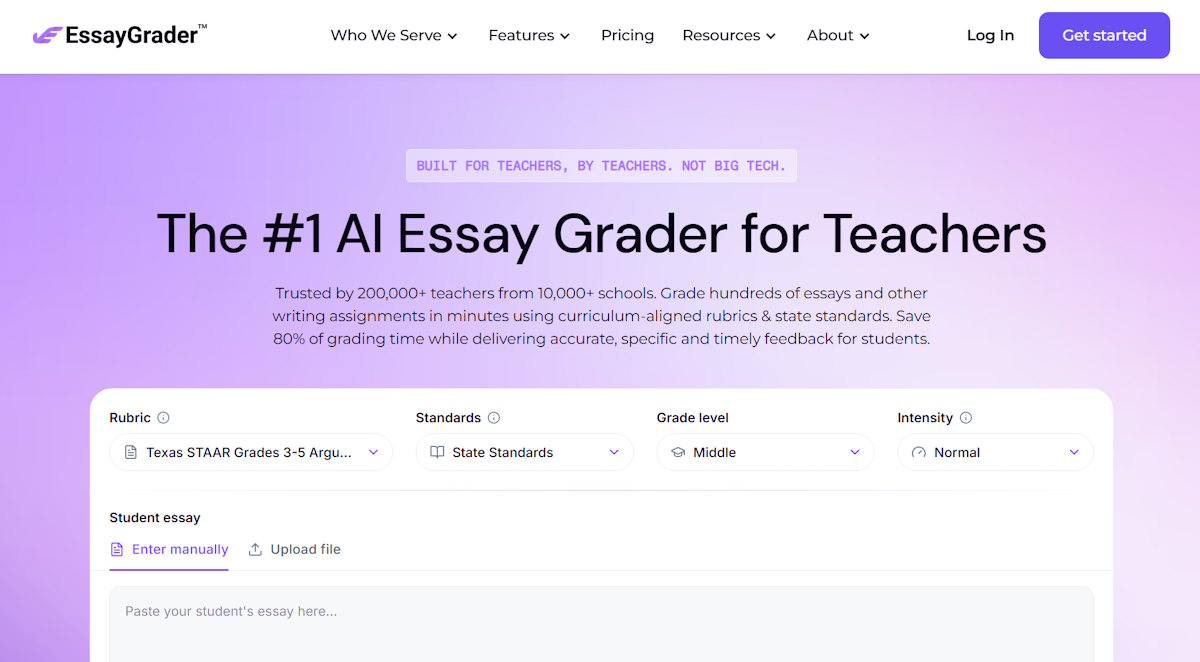
That structure matters because AI grading becomes much more useful when the model has a defined scoring framework to follow.
EssayGrader also publishes its own grading benchmark. According to the company’s latest accuracy page, its system was compared with teacher grading across more than 1,000 papers and showed less than 4% overall variance from human scores. The company also reports criterion-level matches for areas such as thesis and argument, evidence, organization, and grammar. These are vendor-reported results rather than an independent industry benchmark, so they should be read in that context.
The platform has also added more assignment context. Its January 2026 update says reference materials can now be imported from an LMS alongside assignment instructions, including text extracted from charts, graphs, and illustrations.
That makes EssayGrader especially interesting for teachers who want the AI to grade against the actual assignment rather than judge an essay in isolation.
Best for: teachers who want a dedicated essay grading system with detailed rubrics, assignment context, and a grading workflow built around academic writing.
EduWriter AI Essay Grader takes a broader view of what an academic paper needs to satisfy.
The tool evaluates the quality of the writing, introduction, thesis, formatting, grammar, citations, and AI-generated content. It can also use the teacher’s instructions and assessment criteria when analyzing a paper. EduWriter specifically recommends attaching the assignment instructions and comments because the accuracy of the evaluation depends on the context supplied to the grader.
This is a major advantage for academic writing.
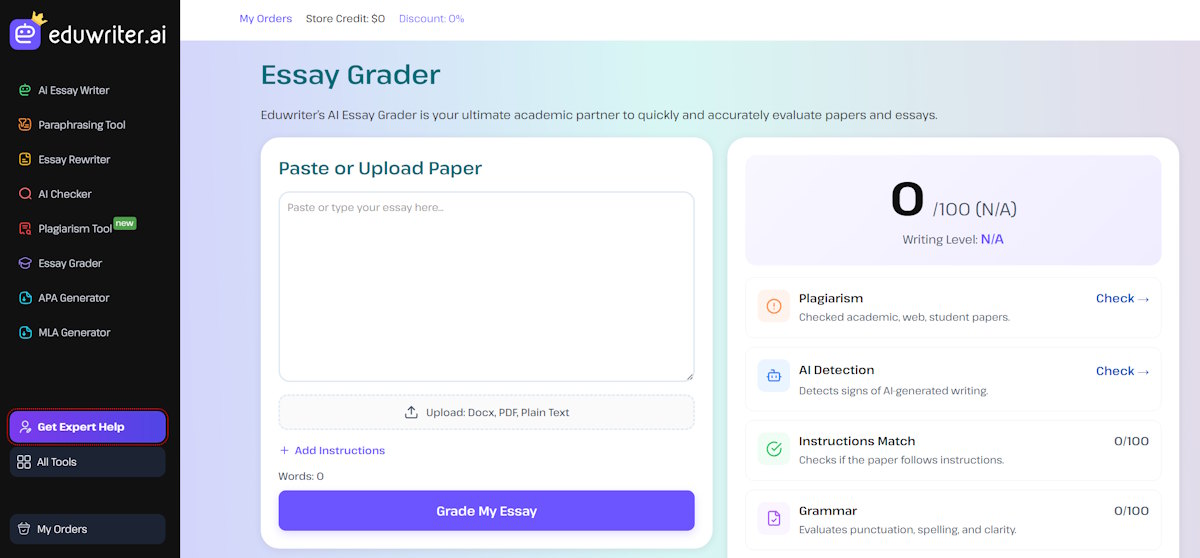
A student can produce an essay that reads well but still fail the assignment because the thesis is weak, the required citation style is wrong, the structure does not follow the instructions, or a required source has been left out. A grader that checks these areas gives teachers a wider assessment than a simple writing-quality score.
EduWriter is also designed for both teachers and students. That makes its use cases slightly different from EssayGrader. A teacher can use it as an additional grading reference, while a student can run the same paper through the tool before submission and identify problems that could affect the final mark.
The platform can use multiple files at once, including the essay and the instructions supplied by the teacher. It also reports that the analysis takes less than fifteen seconds.
EduWriter also brings AI-content analysis into the same report. This can be useful when a teacher wants to inspect both the academic quality of a paper and signs of AI involvement without moving the document between several different tools. Its own documentation describes AI detection as a guide rather than a guarantee, which is the sensible way to treat these results.
Best for: teachers and students who want one essay grader to assess academic quality, assignment requirements, formatting, citations, grammar, and AI content.
CoGrader is a strong option for teachers who want AI to prepare the first grade while keeping the final decision in human hands.
Its system scores each submission against individual rubric criteria and creates feedback for the student. Teachers can use a rubric from the platform’s library, upload their own, or create one based on the assignment. CoGrader currently lists more than 30 available rubrics, covering several essay types and educational standards.
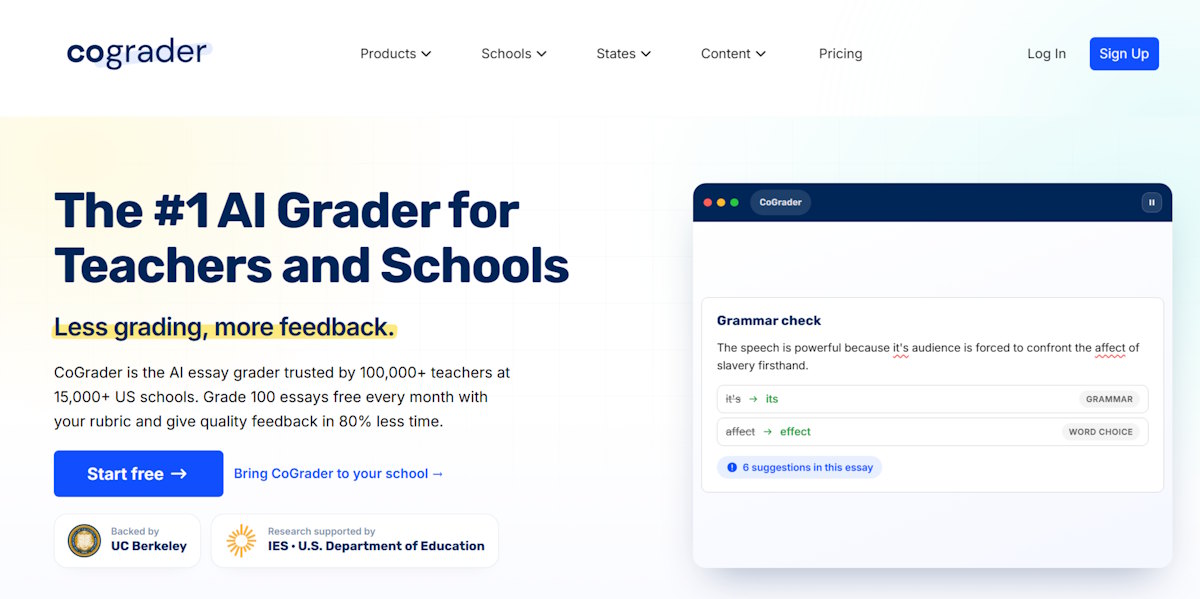
The workflow is straightforward. Student papers can be uploaded or imported from an LMS, the appropriate rubric is selected, and the AI produces a first-pass assessment. The teacher reviews the result before the grade reaches the student.
Its feedback system is another strong point. CoGrader says comments are tied to rubric criteria and can refer directly to evidence from the student’s paper. The platform also tries to end feedback with a concrete next step rather than a generic statement about what went wrong.
That makes it useful when the goal is not simply to produce a score. Teachers can spend less time writing repetitive comments while still reviewing the AI’s assessment before publishing it.
Best for: teachers who want AI-assisted grading with rubric-based feedback and mandatory human review.
Gradescope is a broader assessment platform, but it remains a useful option for institutions that grade different types of coursework alongside written responses.
Its rubric system lets instructors apply the same scoring criteria and feedback across submissions. Rubrics can be structured as lists or matrices, and instructors can reuse comments while moving through student work.
The main difference is focus.
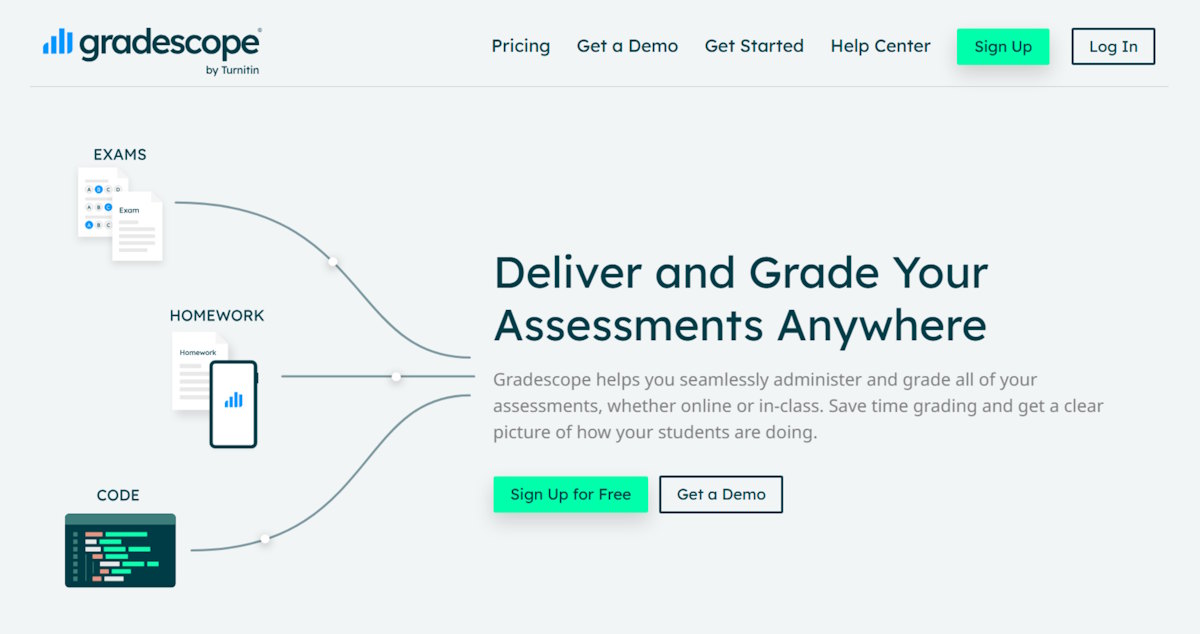
Gradescope is not an essay-only product. Its workflow covers many forms of assessment, which can be useful for universities where written assignments are only one part of the grading process.
The platform also gives students access to rubric information and feedback on graded work, with regrade requests available when instructors enable that option.
For a teacher who wants a specialized essay grader, there are more focused choices above it on this list. For an institution that needs a wider assessment system, Gradescope becomes much more attractive.
Best for: universities and instructors who need rubric-based grading across several types of assignments.
Class Companion combines AI grading with a wider classroom assignment system.
Teachers can create a rubric with AI, import one from a file, choose from a public library, or build a rubric manually. The platform recommends using clear and specific criteria because this helps the AI produce more consistent assessments.
That advice is worth taking seriously with any AI grader. A vague rubric leaves more room for interpretation. A detailed scoring guide gives the model a much clearer target.
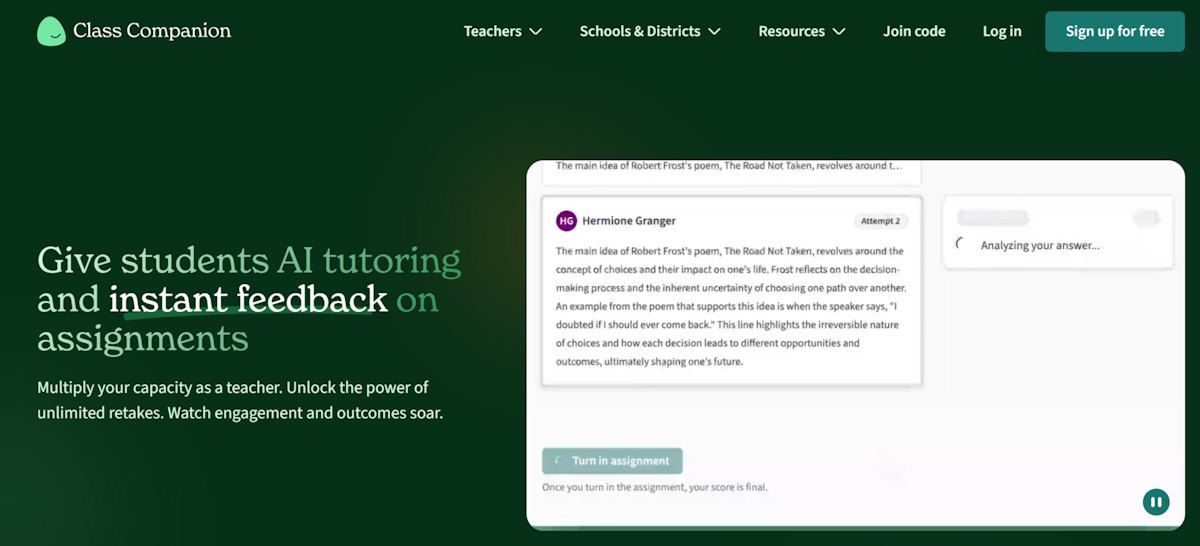
Class Companion also openly acknowledges one limitation of generative AI. Its documentation says that submitting the same answer can sometimes produce different scores because the underlying models have response variability. The company recommends contacting support when major differences appear.
This does not make the platform unusable. It simply reinforces a point that applies to AI grading in general: teachers should review important grades rather than treating the model’s first answer as final.
Best for: teachers who want AI grading and feedback inside a broader classroom assignment platform.
The five tools approach essay assessment differently, so the best choice depends on what a teacher actually needs.
| AI essay grader | Best for | Main advantage |
|---|---|---|
| EssayGrader AI | Dedicated essay grading | Detailed rubric-based assessment and published grading benchmark |
| EduWriter AI Essay Grader | Academic paper evaluation | Checks writing quality, assignment requirements, formatting, citations, grammar, and AI content |
| CoGrader | AI-assisted teacher grading | First-pass grades with rubric-linked feedback and teacher approval |
| Gradescope | Institutional assessment | Rubric-based grading across different assignment types |
| Class Companion | Classroom assignments | AI grading combined with assignment and rubric management |
There is no independent 2026 benchmark that establishes one universal winner across all five platforms.
EssayGrader has the clearest published accuracy claim in this group. Its company reports less than 4% variance from human grading across more than 1,000 papers. It also publishes criterion-level results and says its benchmark is rerun when the grading model is updated.
EduWriter approaches the problem differently. Rather than presenting a single human-agreement percentage, it focuses on the range of information used to assess a paper. The grader can take the essay together with teacher instructions and evaluate writing quality, thesis, formatting, citations, grammar, and AI content.
For a teacher grading against a formal rubric, EssayGrader may have the edge because its scoring system is tightly built around rubric criteria. For someone who wants a wider academic review of the paper and its compliance with assignment requirements, EduWriter is a very strong alternative.
That is why the two tools sit at the top of this list rather than treating the second position as a distant runner-up.
CoGrader is also worth considering when human approval is a firm part of the grading process. Gradescope is more appealing for wider institutional assessment, while Class Companion fits teachers who want grading connected to a broader classroom workflow.
The quality of the underlying model matters, but it is only one part of the equation.
A good grader needs clear criteria. It needs the assignment instructions when those instructions affect the grade. It should explain its score instead of producing a number with no reasoning visible to the teacher.
Rubric design has a direct effect too. Class Companion’s own guidance recommends specific criteria and clear score descriptions because these help the AI grade more consistently. EssayGrader gives similar advice in its rubric documentation, where detailed descriptors are used to distinguish different levels of student performance.
Assignment context can matter just as much. If a teacher asks for an argumentative essay with three academic sources and a specific citation style, a grader should know those requirements before deciding whether the paper meets expectations.
There is another issue: AI detection should not be confused with essay grading.
A paper can be excellent even if an AI detector flags it, and a detector can miss AI-assisted writing. EssayGrader itself says its AI detection result is a guide for closer teacher evaluation and does not affect the grade.
For that reason, AI detection is best treated as a separate signal rather than proof of academic misconduct.
EssayGrader AI and EduWriter AI Essay Grader are the two strongest choices in this comparison, but they appeal to slightly different grading needs.
EssayGrader is the better pick for teachers who want a specialized essay grading workflow centered on rubrics. Its published human-grading benchmark gives it the strongest publicly stated accuracy evidence among the products reviewed here, although the figures come from the company itself.
EduWriter is just as compelling when the goal is a wider academic assessment. It considers the essay itself together with teacher instructions and can review writing quality, thesis, formatting, citations, grammar, and AI content in one evaluation.
For a teacher who wants strict rubric scoring, start with EssayGrader. For someone who wants a broader academic paper review, EduWriter is an excellent alternative and should not be viewed as a weaker second choice.
CoGrader comes next for teachers who want a first-pass AI grade followed by human approval. Gradescope is a better fit for wider institutional assessment, while Class Companion makes sense when AI grading is part of a larger classroom workflow.
The most reliable approach in 2026 is still to use AI as a grading assistant rather than an unquestionable authority. Give it the right instructions, use a clear rubric, review questionable results, and keep the final academic judgment with the teacher.